A new study revisits myrcene's role at CB1 — and finds it does almost nothing alone
The paper challenges a decade of folk theory about the "couchlock" terpene.
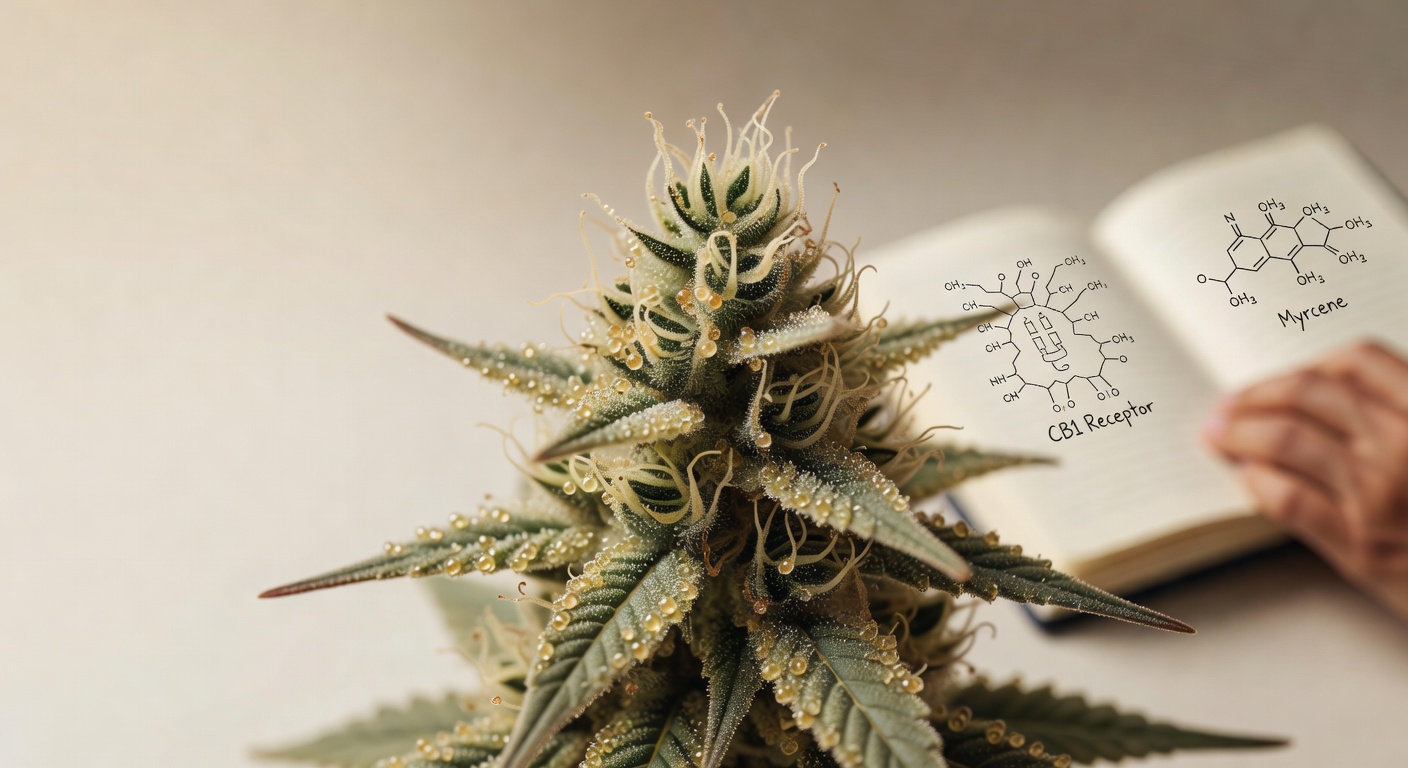
A new in-vitro study from Hebrew University, published this month in the Journal of Natural Products, finds that myrcene shows essentially no measurable activity at the CB1 receptor in isolation — directly challenging a decade of folk theory that myrcene is responsible for the sedating, "couchlock" quality of indica-leaning cultivars.
The researchers were careful to note what their result does and does not say. Myrcene at physiologically realistic concentrations does not bind CB1. It may still modulate THC's effect at CB1 indirectly — through membrane permeability, metabolic competition, or co-receptor effects. The entourage hypothesis, in other words, is not dead. It is just less simple than the "myrcene = sedation" shorthand suggests.
For consumers, the practical takeaway is modest. Strains high in myrcene do tend to be reported as more sedating. That correlation is real. The causal story is more complicated than the COA can show.