The case against printing THC% on the jar at all
It misleads consumers, distorts producer incentives, and tells you almost nothing about how the flower will feel.
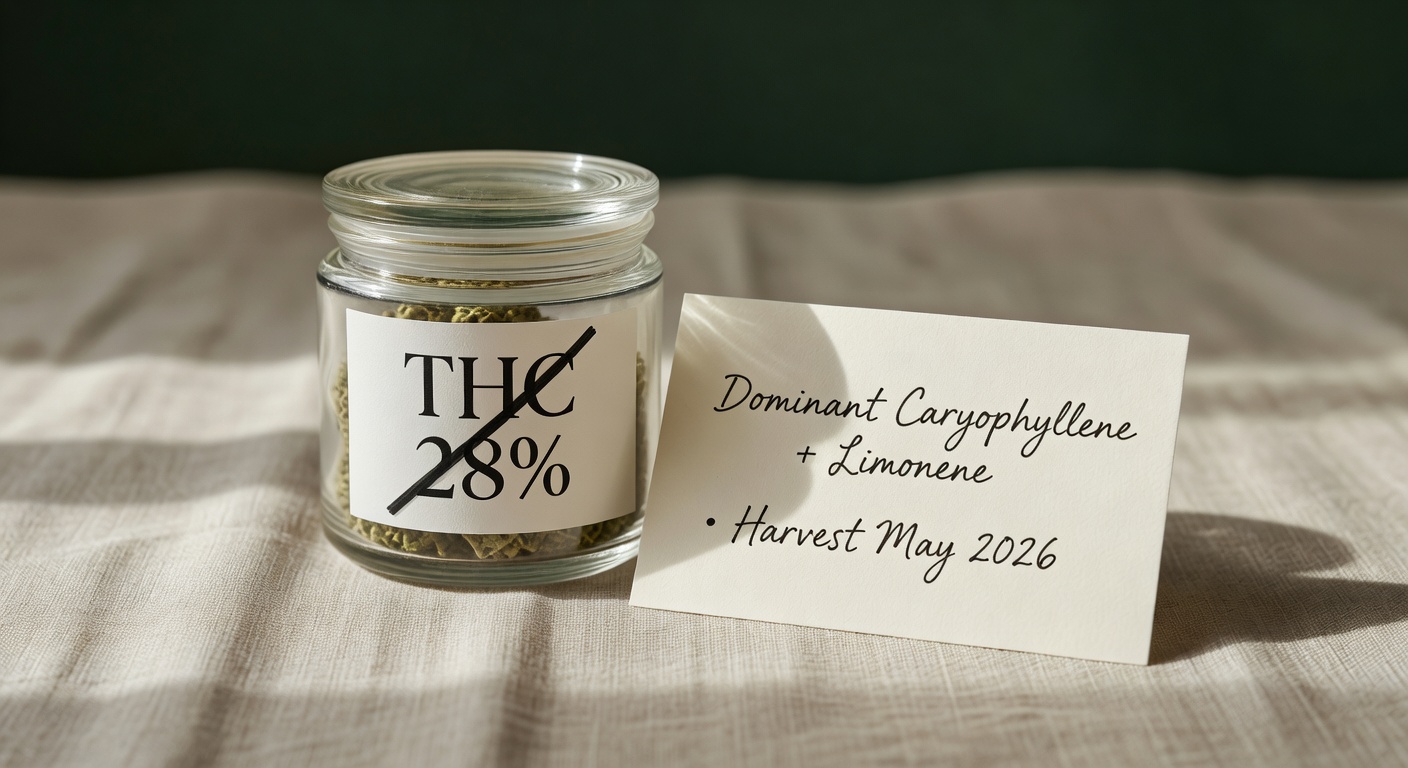
I want to argue for something that I think is currently unthinkable in legal cannabis retail: that the THC-percentage number on the jar should not be there at all.
Start with the data. There is now a substantial literature, much of it published in the last three years, showing that THC percentage is at best weakly correlated with how a cannabis product is experienced by the consumer. Terpene profile is a much stronger predictor. Cannabinoid ratio is a much stronger predictor. The cultivar's genetic background is a much stronger predictor. THC percentage is the noise floor, not the signal.
But THC percentage is also the only number the regulator demands on the jar, the only number the retailer trains its budtenders on, and the only number consumers compare across products. So the entire incentive structure of the legal industry has been bent around a number that does not, in any meaningful sense, describe the product.
“The THC percent on the jar is the noise floor, not the signal.”
What we have built is the cannabis equivalent of grading wine on alcohol by volume. A 14.5% chardonnay is not better than a 12.5% one. A 28% THC strain is not better than an 18% one. The industry knows this. The labels do not say so.
I am not arguing for less information on the jar. I am arguing for the right information. Total cannabinoid content. Dominant terpene. Cultivar lineage. Harvest date. A signal that points toward how the product will actually behave in the body — not a number that is, at this point, mostly an artifact of which lab the producer chose this quarter.